For the first time in what seems like forever, all eyes are on the Washington Wizards. It may only be Summer League – a meaningless slew of games set in the summer doldrum – but it matters for Washington fans nonetheless. The Wizards have not been relevant in nearly a decade, when they pushed the Boston Celtics to a Game 7 in the second round of the 2017 Playoffs. However, thanks to AJ Dybantsa, the number one pick in the 2026 NBA Draft, along with the additions of former multi-time All-Stars Trae Young and Anthony Davis, there is an unprecedented level of excitement and hope in Washington as the team prepares for the upcoming season.
There has long been a perception that the Wizards are one of the worst-run and historically unsuccessful franchises in the NBA – which is valid, seeing as Washington hasn’t accomplished anything noteworthy on the basketball court since the 1970s. Thus, the Wizards have historically been unable to attract top-tier talent through free agency. This left the franchise with only two options: trade, or draft, for star players.
Washington’s lead decision-makers, General Manager Will Dawkins and President Michael Winger, have done just that throughout their entire tenure in the front office. From wisely getting off Bradley Beal’s massive contract to drafting Dybantsa and trading for Young and Davis, the Wizards have completely remade their league-wide image (save for Young’s perplexing contract extension). Up until this year, Washington had unfortunate draft luck, but still made the most out of it: they drafted major contributor Kyshawn George with the 24th pick two years ago; last year, the franchise drafted Tre Johnson, a three-level scorer, and Will Riley, a lanky, tall, and unorthodox guard with immense upside.
Dawkins and Winger don’t just draft basketball players; they draft people, first and foremost. When evaluating a prospect, they place a heavy emphasis on players’ work ethic, personality, and their willingness to learn and improve.
In an interview regarding how he approaches the draft process, Dawkins stated, “A big part of it is spending time with them as players, and going on campus and interviewing them and seeing what they’re about…It’s all about knowing them as people, and we draft people not just players.”
This has been evident throughout this year’s Summer League games. The entire Wizards roster was present courtside to watch Dybantsa’s Summer League debut, including Anthony Davis, who has been the subject of unrelenting trade rumors all offseason. During Young’s press conference regarding his new contract extension, the team was there to watch and give support. This goes to show that these players enjoy each other’s company, willing to learn from each other, and bond off the court, which can go a long way in terms of how much this team is able to achieve next season.
Speaking of the Summer League, the Wizards have had great success thus far. In two games, the team has two wins with no losses to speak of – and despite it only being the Summer League, this feat is undoubtedly impressive for a franchise that has largely been losers on the court for the past half-century. How the Wizards reached this point, though, is even more noteworthy.
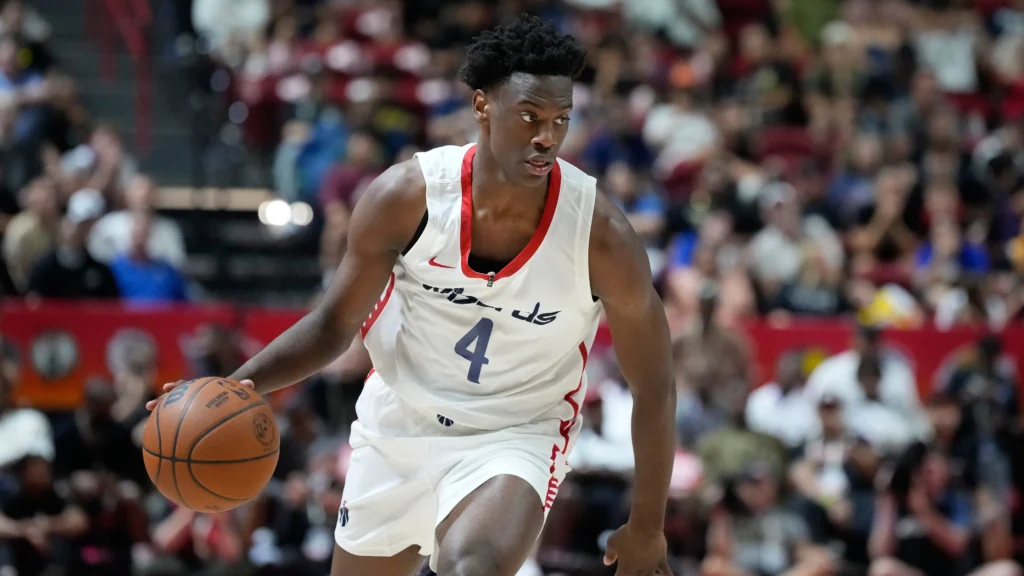
Dybantsa has been billed as a potential NBA superstar, and through two games for Washington, he has certainly lived up to the hype. In his debut against the Utah Jazz, the No. 1 pick scored the Wizards’ first points in Summer League in true Dybantsa fashion. Handling the ball near the center-court logo, Dybantsa navigated through a pick and roll with a Jazz player smothering him. With a nifty hesitation to freeze the defender, he used his otherworldly athleticism to accelerate quickly and drive towards the basket. Using his long strides and tremendous flexibility, he scored a reverse layup after exploding off of two feet:
Less than half a minute later, Dybantsa demonstrated his passing potential, threading a perfect pass to Riley in transition for an and-one jam:
Minutes later in the first quarter, as Dybantsa blew by the first line of defense looking for another paint basket, he was instead met by another defender. This time, instead of muscling his way past, he calmly stepped back, elevated, and nailed a short jumper as he got fouled:
Dybantsa also demonstrated his ability to create his own shot under pressure. Late in the first quarter, with the shot clock at 4 seconds, he quickly went to work. Using his quick first step, he found a good angle and drove by a defender at the three-point line. Three defenders began to collapse into the paint to provide help, but it did not matter. Gathering the ball near the free throw line, he took one gargantuan step and used his exceptional leaping ability to posterize the defense:
Dybantsa also had 8 free throw attempts in his debut, which would have amounted to 15 had the NBA not implemented a one free throw rule in the Summer League. His ability to generate rim pressure this early in his career is exactly what Washington’s roster needs, as his physical, grinding style complements the games of the Wizards’ other draft picks such as Tre Johnson, Riley, and George, who all struggle (at varying degrees) to get to the rim.
Defense has been a concern for Dybantsa as he enters the league, but he has answered his critics through his first couple of Summer League games. In his second outing, he tallied three steals and two blocks, showing great on-ball defensive effort after he was frequently chided for his lack of stocks (steals and blocks) during his lone college season.
Midway through the first quarter, Dybantsa switched onto No. 7 pick Darius Acuff after a screen was set. Because Acuff, being a small guard, could use his explosiveness to get by the bigger Dybantsa, the latter sagged off Acuff slightly to prevent this scenario from unfolding. Acuff, with space, began to launch the three pointer, but Dybantsa was able to use his 7-foot wingspan to block the attempt at three:
This play demonstrates that Dybantsa has the ability to be a versatile defender at the NBA level if he remains engaged on the defensive end. With Trae Young and Anthony Davis on the Wizards to carry most of the offensive burden, Dybantsa will be able to shift more of his energy towards the defensive end. Most importantly, he has shown a desire to excel defensively:
“I think I can be a first team All-Defensive player. I’m just trying to make an impact on that end.”
While there was plenty of good to dissect from Dybantsa’s first couple of games, there are also areas in which he needs to improve. The good thing for him is that they can all be improved through more practice and repetition. By far the most concerning issue is his three point shooting, as through the two games he played, he shot 1/11, or 9.1%, on his threes. His shot seemed to be flat, with his misses bouncing off of the front of the rim. He was not getting enough lift or arc on his threes, and this may be due to the fatigue of routinely playing against double and triple teams throughout games. Dybantsa will need to tweak his release a bit in order to become a competent NBA shooter, while also practicing his shot more.
Dybantsa also seemed unwilling to pass the ball when he was double or triple teamed. Instead of passing, he often settled for contested, inefficient fadeaway midrange shots. This might be because of the lack of quality players surrounding him, but in the NBA, the Wizards cannot afford empty offensive possessions if they are trying to be competitive and win games. As he develops into a star player, he will learn to balance creating for others and looking for his own shots, similar to what Anthony Edwards has been learning the past couple of seasons.
All in all, through two Summer League games, AJ Dybantsa has looked every bit like a No. 1 pick, averaging 25 points, 7 rebounds, 2 assists, 2.5 steals, and 1.5 blocks per game. It’s not just Dybantsa who is impressing in Summer League for Washington; sophomores Johnson and Riley have also had standout games, with 26 and 32 points respectively. Johnson, in his first Summer League game of 2026, looked lethal from three as always, but also showcased his stronger frame by absorbing contact on his way to finishing at the rim and the midrange. Riley, in his second 2026 Summer League game against the Kings, looked more comfortable from three (he shot 75% from long range in the game) and was able to play through more contact to go along with his creativity on the ball. Both players need to improve their defense, as Johnson routinely got blown by and Riley was largely unable to contain stronger players with his slight frame.
Dybantsa, Johnson, and Riley all seem to be a level above the Summer League competition. From a No. 1 pick and sophomores who have had a good amount of NBA experience, this is exactly what Washington fans wanted to see from their Summer League “Big 3.” If Washington’s Summer League performance – two wins in as many games – is a precursor for what’s to come in October and beyond, Wizards fans have everything to be excited about for the upcoming season.